Slovenia: a mountainous land covered in lush green forests. Crystal blue waters flow through its rivers and a fairy-tale church is perched on an island amidst its largest lake, Lake Bled.
This country, the first of the former Yugoslav countries to declare independence, is scarcely 30 years old, but its people are proud of its green credentials.

Green Slovenia
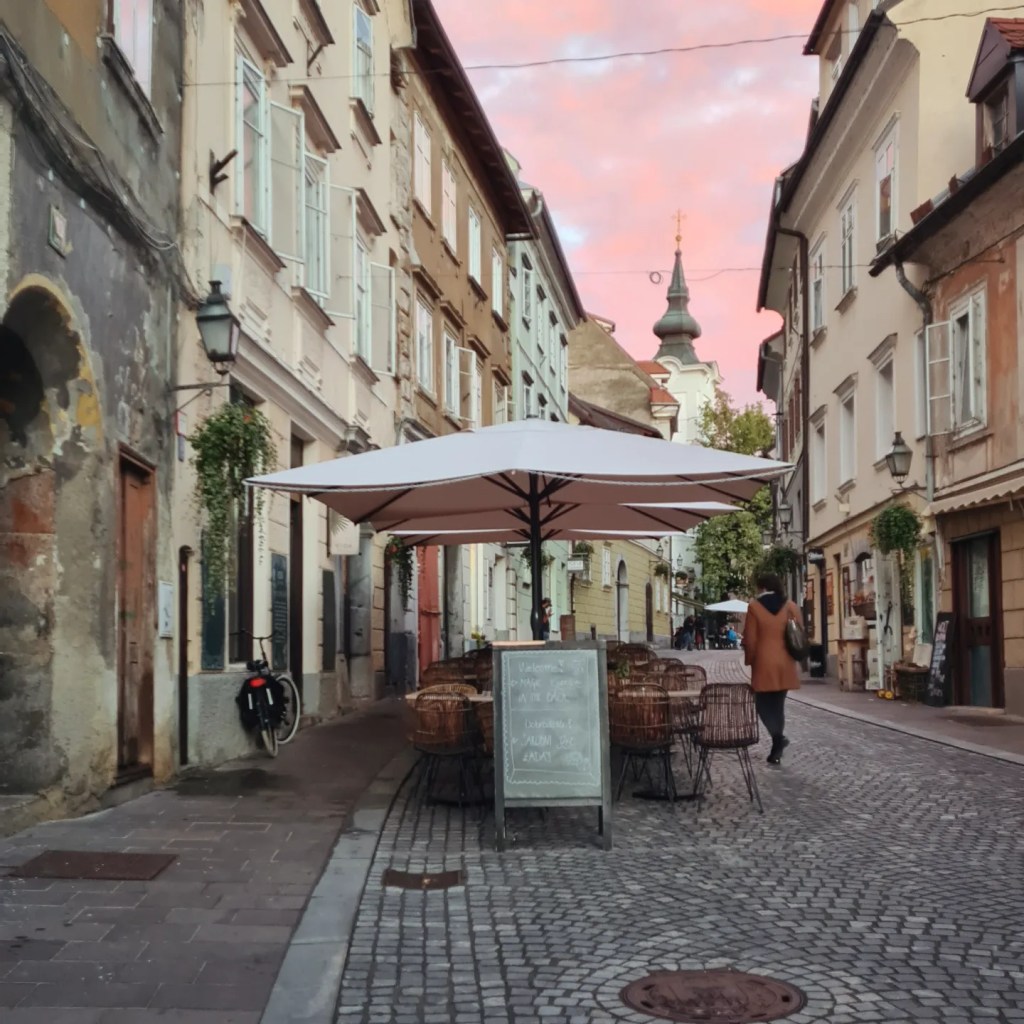
On the streets of its capital, Ljubljana, where the number of outdoors clothing and adventure gear shops is striking, a tour guide told the group what he felt the best thing about his fledgling country is.
“In Slovenia, we keep it local,” he explained. “The market in our main square – most of the produce is sourced locally. We drink 90% of the wine we produce. If we’re seeing friends, we rarely travel more than half an hour.”
The country’s environmental record is strong. Over half of its surface area is protected by law, which might go some way to explaining how almost 60% of it is covered in forest. Its brown bear population has rebounded so strongly from near-extinction at the end of World War II that it now needs to be culled. Wolves and lynx roam freely. Perhaps most impressively, although Slovenia represents less than 0.004% of Earth’s surface area, it is home to as much as 1% of all known living species on the planet. The black olm, a mysterious cave-dwelling amphibian that can live to 120 years old, is unique to Slovenia.
It should come as no surprise that Ljubljana was anointed Europe’s Greenest Capital by the European Union in 2016.
“We also fine people for putting recycling in the wrong container,” the guide continued enthusiastically.
That might be further than some people would like to go – though looking at the state of the recycling in the communal bin sheds of some flats in London, perhaps it is not such a bad idea. And sourcing more produce locally is an idea that people of all political persuasions could likely get on board with, and will benefit both local economies and the planet.
Independence
But what of this tiny country’s recent history? It turns out that the story of its independence, occurring so recently that it falls within this author’s lifetime, is quite remarkable.
Imagine that Scotland declared independence from the United Kingdom, knowing full well that the following day London would order the tanks and artillery of the British Army to roll across the border and re-take Scotland by force.
Imagine further that the Holyrood authorities outwitted London by ensuring that a secret command structure had already been put in place, allowing them to take control of a Scottish section of the British Army and fight back effectively. Holyrood also puts London on the wrong foot by declaring independence a day earlier than planned, and triumphs after a brief conflict.
This happened in the Balkans in 1991. Slovenia, dismayed by the Serbian President Slobodan Milosevic’s attempts to consolidate federal power into a centralised, Serbian-dominated Yugoslavia ran from Belgrade, had announced its intention to secede. The Slovenians predicted, correctly, that Yugoslavia would use military force to try to prevent this.
The Slovenians were aware that the Yugoslav Army would try to assert control over its Slovenian branch, the Teritorialna obramba Republike Slovenije, or TO. So, months ahead of the declaration of independence, they established a secret, alternative command structure for the Slovenian TO, the Manevrska struktura narodne zaščite, or MSNZ. When the Yugoslav Army tried to take control of the Slovenian TO, the TO’s command structure was simply replaced by that of the parallel MSNZ.
With an armed force at their command, the democratically elected Slovenian authorities declared independence, in keeping with a referendum vote 88% in favour of this the previous year. As predicted, Belgrade sent in the Yugoslav Army. But the TO succeeded in stalling the advance of their militarily superior foe, and ten days later the two sides signed the Brioni Accord on the Croatian Brioni Islands, granting Slovenia its independence. The conflict became known as the Ten Day War.
“We were lucky, our war only lasted ten days,” the tour guide explained, gratefully. Other Balkan countries were not so fortunate, as this journey will reveal in the coming weeks.
A visit to Lake Bled and Ljubljana leaves an impression of Slovenia as a forward-thinking and environmentally friendly nation, proud of its independence and thankful for the relatively bloodless manner in which it was attained.
The next stop will be the country that housed the government of Yugoslavia, the same government that sent its army to fight in Slovenia for those ten days in 1991. That country is Serbia.
 Somewhere Must Be Doing It Better
Leave a comment