What had you achieved by the age of 30? Even many great historical figures had limited resumes upon reaching this relatively tender age. All that Julius Caesar had accomplished was to be kidnapped by pirates. Genghis Khan’s curriculum vitae was similarly embarrassing: a major falling out with, and defeat in battle by, a childhood friend.
Not so for North Macedonia’s most famous son. By the end of his twenties Alexander the Great had created a sprawling Macedonian empire, reaching from the Balkans to Africa and as far as India – and 21st century Skopje wants you to know this.
At the centre of Macedonia Square stands a gargantuan statue of Alexander, astride a battle horse, sword aloft, towering 80 feet over mere mortals below. In front of the Old Town are more statues, including one of Alexander’s parents. Legend has it that his mother had a strange mark, in the shape of a lion, on her belly during the pregnancy, which marked the child out as destined to be brave. Accordingly, there are enough statues of lions throughout the city to create a pride.
There is a statue of Alexander’s father, Philip II, and a statue of mothers nursing infants, in honour of Alexander’s mother. Aside from Alexander’s family, there are also statues of the creators of Cyrillic script nearby, statues of other famous Macedonians, and a bridge adorned with dozens of statues on either side. Looking skyward, statues adorn the rooftops. There are even statues of working people and the poor.
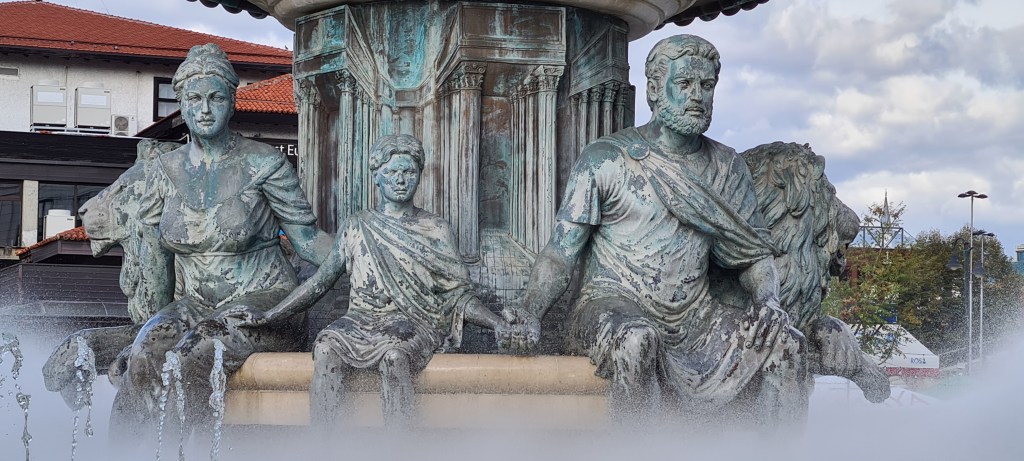
“They went a bit overboard,” says one local, with a smirk.
“I understand the statue of Alexander. I even get the statue of a shoe-shiner. But we don’t need a statue of a beggar,” says another.
Why so many statues?
To boost tourism in the wake of the financial crisis, and as a mechanism to bolster national identity and pride in a newly independent North Macedonia, 2010 saw the then-government announce their controversial ‘Skopje 2014’ project. €700 million was splashed on dramatic columns, grand facades, and statues. Lots of statues. There are now in excess of 100 statutes in a relatively small area in the city centre, along with several large, new government buildings, museums and bridges, all built in the last 10 years in a neo-classicist style.
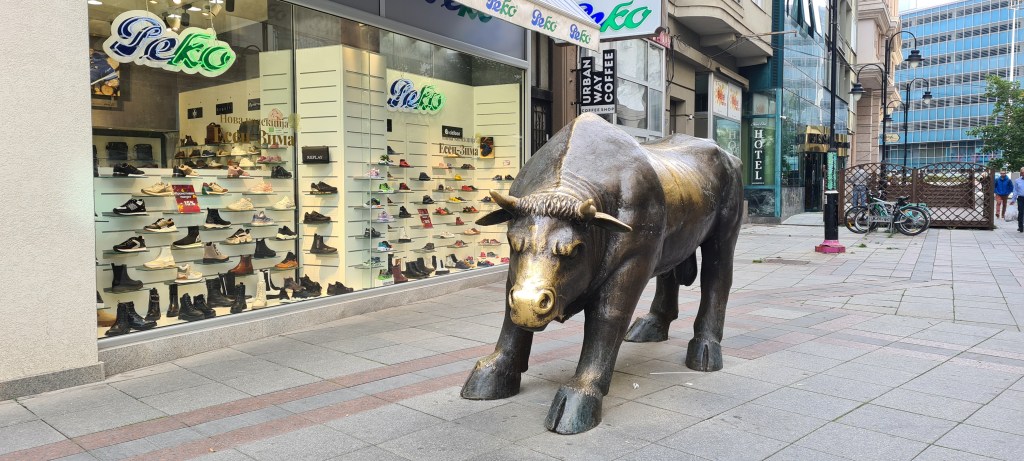
The government did not stop with statues and museums. A huge triumphal arch, made of stone and based on Paris’ Arc de Triomphe, is situated just off the main square. Other imitations include a Wall Street-like golden bull placed outside the city’s former stock exchange – nowadays the building is a shoe shop – and a White House-style government headquarters. There were plans for a London Eye, though the latter was scrapped due to funding concerns. Together with the statues, these monuments lend the city a slight Las Vegas vibe, albeit with more actual history to boast of.
Whether you agree with the previous government’s intentions or not, it is undeniable that the centre of this young country’s capital has been transformed. But is there more to Skopje than monuments and masonry?
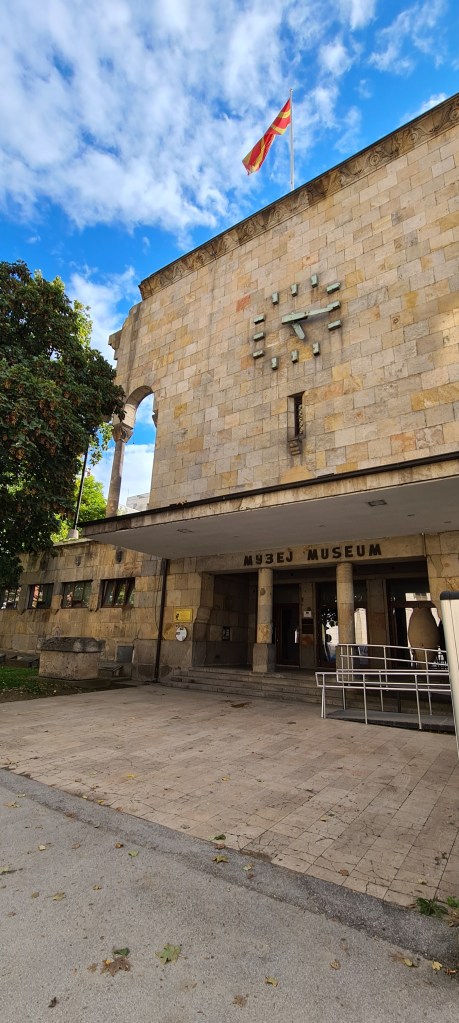
80% Skopje was destroyed in a catastrophic earthquake in 1963. Incredibly, the Stone Bridge in the centre, constructed by the Eastern Roman Empire, survived and is in full use to this day. Likewise, the city’s Ottoman Old Town, one of South-East Europe’s largest, also survived.
Venturing into the Old Town reveals the city’s Ottoman heritage. Its mosques also survived the quake (minus their minarets). Today there is a street devoted to jewellery, where curiously pink-coloured Macedonian rubies, or beautiful gold bracelets, can be purchased. There are bridal shops selling resplendent wedding dresses. A Roman castle, partially restored, overlooks the bazaars and stalls.
The Old Town is where you can sample much of the city’s cuisine. Skopje is not an easy place to be vegetarian; in some establishments the only non-meat dish is baked beans. Even vine leaves come with ground beef wrapped inside, rather than the rice that one might expect elsewhere.
But if you are willing to eat meat then you will find it is bountiful, and can be complemented by coffee, tea, or salep, a Balkans favourite hot drink made from orchids. Despite the strong Muslim influence, alcohol is also readily available.
Although the city commemorates the fearsome warrior Alexander, it also venerates a famous resident with a very different temperament. 1979 Noble Peace Prize winner Mary Teresa Bojaxhiu, better known as Mother Teresa, was born in Skopje in 1910. The world-renowned nun and saint has a recreation of her house near the city centre that doubles as a museum to her life’s work, helping the poor in Calcutta, India. The city’s triumphal arch is adorned with Mother Teresa quotes on metal plaques.
Other countries want a piece of North Macedonia’s history. Greece have accused Macedonia of appropriating symbols, figures and names that Macedonia’s southern neighbour claims are historically part of Greek culture. In 1995, Greece forced Macedonia change its flag and relinquish its use of the Vergina Sun symbol. Macedonia has avoided explicitly identifying the huge statue of Alexander for fear of offending Greece further; the statue’s official name is ‘Equestrian Warrior’. Because a region of Greece itself is also called Macedonia, Greece exerted pressure on the EU and NATO to mandate that Macedonia must add the qualifier ‘North’ to its name before it would be invited to join either institution. In 2018, the country officially became known as The Republic of North Macedonia.
Skopje has the feeling of a city in the process of asserting itself. Its bold building project has moulded a new look for the capital of this young country with ancient history. Like much of the Balkans, its culture is a fascinating melting pot of West meets East, Europe meets Ottomans, but in North Macedonia there an additional classical, ancient element thrown into the mix.
Locals and visitors alike may react with laughter or scorn to the multitude of grand buildings and imposing statues that Skopje now boasts. But, like a fine wine, these are the sort of constructions that age well. In a few decades’ time it may be that nobody could imagine Skopje without its new, ‘old’ look, and it will be all the richer for it.

 Somewhere Must Be Doing It Better
Leave a comment