A country that breaks ties with the USSR because it deems that the Soviets are not deeply enough committed to the communist cause must be extreme. Such was the case with Communist Albania in 1961. Later, after their 1978 break with Communist China, Albania was completely isolated, an international pariah. Some refer to Albania pre-1991 as the ‘North Korea of Europe’.
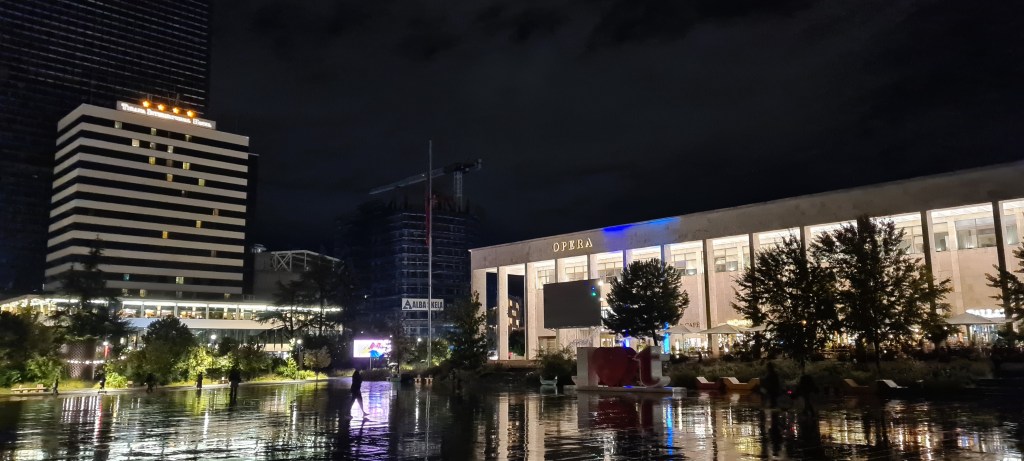
Albania today has opened up, and anyone is welcome to walk the streets of its capital, Tirana. A vast central square is named after Skanderbeg, their 15th century hero who battled the Ottomans. The Communist-era Palace of Culture has found a new life as an opera house, and the Tirana International Hotel, once the loftiest building in the capital at 15 storeys, is now dwarfed by a new construction behind it which is at least twice as tall.
“They were terrible times,” explained one person old enough to remember the dark days of communist leader Enver Hoxha’s terrifying authoritarian regime. Stories of night-time arrests and prison camps abound. Neighbours were encouraged to spy on one another, by a security apparatus reminiscent of East Germany’s Stasi.
“My uncle was arrested in the 1970s, for no apparent reason, and sentenced to 20 years,” one Albania recalled grimly. “He died in prison. In the ’90s we were allowed to read his file. I don’t know what was worse: the graphic descriptions of torture, or the note explaining that it was a family friend, who has been present at many birthdays and weddings since, who had given the tip-off that led to his arrest”.
No wonder people are keen to move on from those times. In 1991 a mob toppled the 10m high statue of Hoxha that used to overshadow Skanderbeg Square, and a change of regime swiftly followed. People swiftly embraced a new, more open way of life.
“Everyone was so excited when Coca Cola arrived in Albania in 1993”, related one younger Albanian. “Lots of people kept their empty first bottle as a memento. My grandfather used to get his off the shelf every time guests came round. He’d place it in the middle of the table, instead of a candle, and fill it with raki, which the guests would be forced to drink.”
Raki is a Balkans drink, a strong spirit that should be sipped rather that downed, unless the aim is a throat that is thoroughly aflame. It is purported to have healing powers for colds and ‘flu, but is also simply a sociable beverage to share with guests and friends.
Tirana is a bustling, busy city. A meal at a traditional restaurant may feature a live band, with an accordionist; some have dishes such as sheep’s head on the menu. Bars can be found in a variety of locations, including one in a converted nuclear bunker, which is not surprising since there is no lack of bunkers. Paranoia gripped Enver Hoxha, who had 175 000 built across the country as a whole.
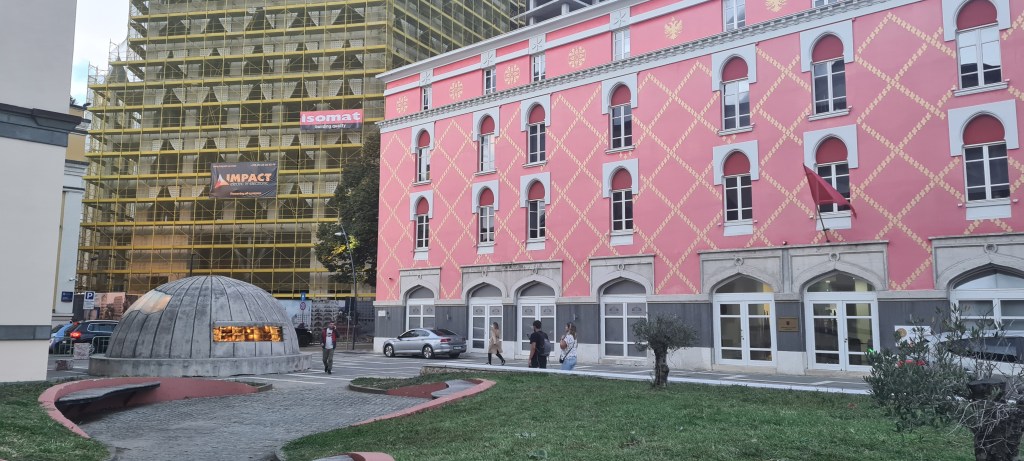
One particularly large bunker on the edge of town has been converted into a museum of 20th century Albanian history. As well as the horrors of the Hoxha regime, there are exhibits detailing the country’s pre-war history. Pre 1939, Albania was led be a politician who decided to declare himself royalty: the self-proclaimed King Zog.
King Zog’s reign did not end happily. He was married in 1938 and had the Italian Foreign Minister as his best man. In 1939, that very same Foreign Minister was personally responsible for planning the (successful) Italian invasion of Albania. King Zog lost his country, and one can only presume that the Italian Foreign Minister lost King Zog’s friendship.
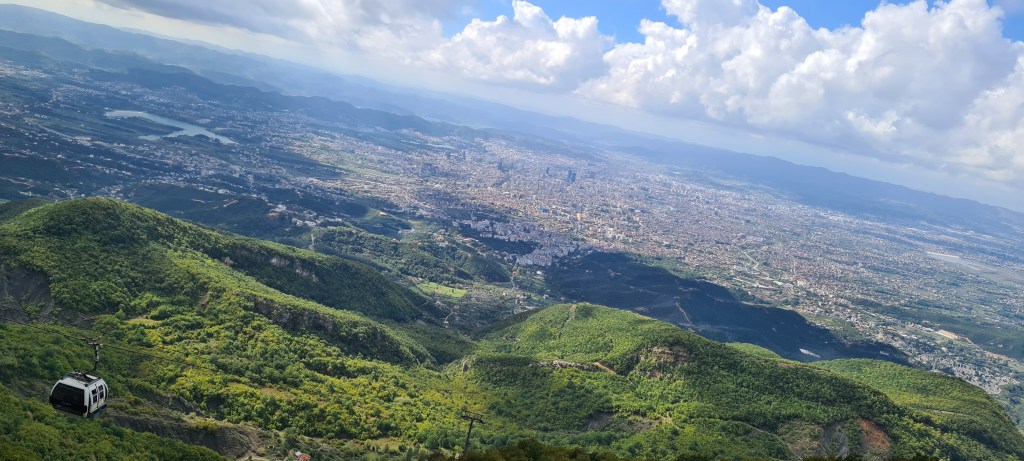
Next to this museum is the Balkan’s longest cable car. Riders are treated to a 15-minute journey over densely wooded mountainside, eventually alighting over 1000m above sea level, to enjoy a commanding view of the city below.
There has been considerable investment in the cable car, but wander just directly outside the front door of the compound and waste ground, populated by stray dogs, greets you. A large abandoned building is a two minute walk up the unkempt path. The country is still struggling to modernise after its communist days, and corruption is reportedly a major issue in the government.
Although unscrupulous politicians may continue to be a thorn in the country’s side, Albanian society has plenty of strengths. One is that of family and neighbourhood ties.
“In the Hoxha days people often lived their whole lives in the same flat or apartment block,” remembered one resident. “This meant that the neighbourhood was very tight-knit. Everybody knew everybody. And a lot of those social ties remain today.”
“You won’t find many nursing homes in Tirana,” added another. “Because everyone looks after their elderly relatives.”
Whatever else can be said of the current regime, and Albanian society in general, one thing is for sure. They can be credited with a fantastic coup against the Russians in the wake of the invasion of Ukraine in February.
Whilst other countries condemned Putin in their parliaments and in their papers, Albania responded by renaming the street in Tirana that the Russian Embassy is located on as ‘Free Ukraine Street’. This means that any written correspondence to the Russian Embassy in Albania would need to be addressed to:
Russian Embassy,
Free Ukraine Street,
Tirana,
Albania
The Russian Embassy recently announced that they are relocating, for ‘technical reasons’.
 Somewhere Must Be Doing It Better
Leave a comment