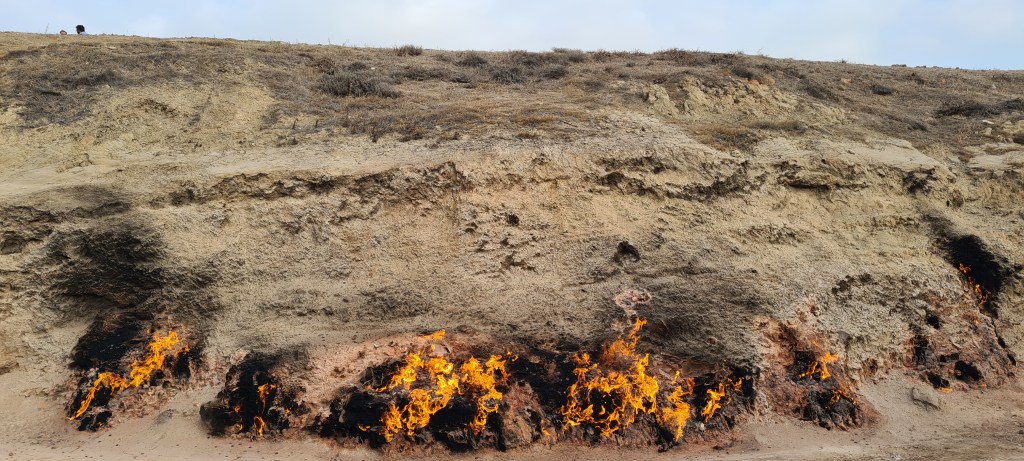
The ancient Greeks believed that Prometheus stole fire from the gods, leading Zeus to nail him to a mountain in the Caucasus as punishment. Roman historians referenced a ‘Land of Fire’ in the same region. For centuries, the people of this area practised Zoroastrianism, constructing temples around flames that leapt out of the ground. Today, Yanar Dag (the ‘Burning Mountain’) draws tourists who marvel at the flames licking its rocks; nobody knows for how many thousands of years they have been burning.
This country is Azerbaijan, and its name means ‘Land of Fire Protectors’, referencing its Zoroastrian past. The cause of the spontaneous fires is vast reserves of natural gas, which occasionally seep through the land and escape, such as at Yanar Dag and the former temples. Coupled with huge oil fields, these fossil fuels have shaped modern Azerbaijan.
The capital, Baku, is like Paris met Dubai on the Caspian Sea. A beautiful waterfront stretches around the bay, streets of high-end Western designer outlets are linked by marble-lined underpasses, and colossal buildings gleam in the sun. The most famous are the Flame Towers, a trio of skyscrapers that define the skyline. At night, they are illuminated in a dazzling light display that alternates between a waving Azerbaijan flag and pattern of flames.
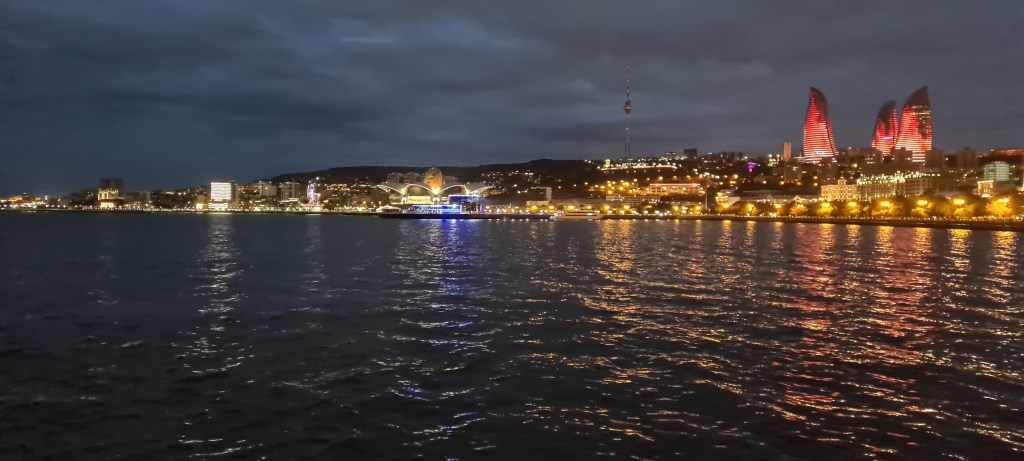
The city centre is modern, and startlingly clean. There is not a piece of litter in sight on the streets, and if you drop a chip in a fast food joint an attendant will have swept it up before you have chance to bin it yourself. The Old Town, a UNESCO World Heritage Site, is beautifully preserved; upmarket shops and hotels abound.
Oil wealth has driven this development. Drive along the Absheron Peninsula, a few miles out of Baku, and the coast is dotted with oil wells. Out to sea, numerous oil rigs are visible. The country has embarked upon a massive building programme since independence in 1991, and the completion of an oil pipeline to Turkey in 2006 only accelerated things. Hosting events such as the 2015 European Games and an annual Formula One Grand Prix all forms part of a huge drive to boost tourism.
This is not, however, the nation’s first oil bonanza. In the mid-19th century Azerbaijan was one of the first countries to sink oil wells, and by 1900 was one of the world’s leading oil producers. A resulting class of fabulously rich oil tycoons took to constructing imitations of European, particularly Venetian, buildings, supposedly as presents for their wives. The architectural legacy of this first oil boom can still be seen today.
Unsurprisingly, Azerbaijan does not appear too concerned with carbon emissions or global warming. Recycling facilities are scarce. Plastic bags are handed out merrily in supermarkets, bottled water is widely consumed and, on the road, the car is most definitely king.
“When the roads are clear my commute is 30 minutes,” one Baku worker explained. “At rush hour, it takes me two hours.” The sea breeze is tinged with petrol.
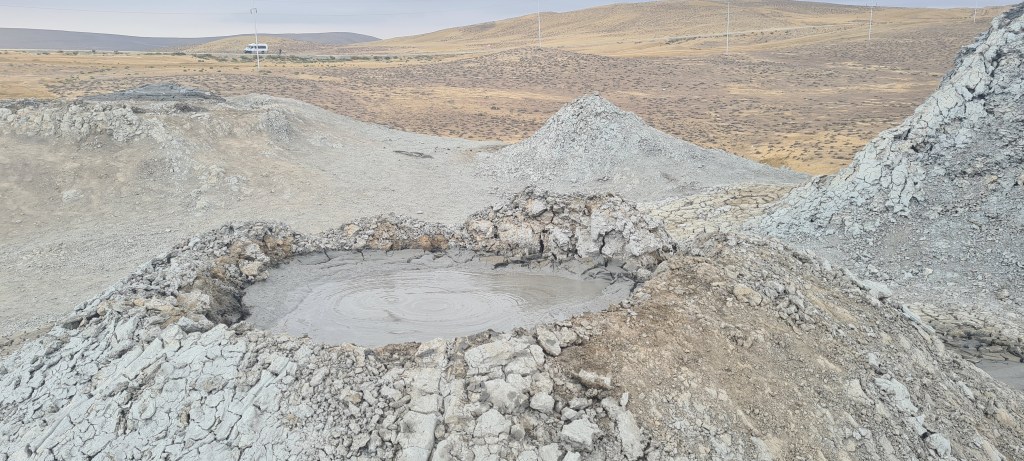
Outside of Baku, the rest of the country has been somewhat left behind. Provincial cities such as Quba are less developed, the streets are far less clean, and the feeling of oil-driven affluence is absent. Despite this, it is worth getting out of the capital. Attractions such as the 10 000-year-old petroglyphs at Qobustan are fascinating, and the nearby mud volcanoes, set in a barren, Martian landscape, are downright bizarre. Venture to the far north of the country and eagles circle above craggy mountain peaks near Khinaliq, a 5000-year-old mountain village. Thought to be the highest village in Europe, there was no tarmac road until 2003 and it is cut off every winter by snow. Local folklore tells that the locals are descendants of Noah; even today, they speak a different language to the rest of the country. Many work herding sheep.

All over Azerbiajan, one name crops up repeatedly. Heydar Aliyev Road, Heydar Aliyev Cultural Centre, even Heydar Aliyev International Airport.
“He was a strong politician,” a woman in her thirties recounted.
“He was very strong,” echoed a soldier who fought in the recent conflict.
Strongman Heydar Aliyev ruled Azerbaijan from 1993 until his death in 2003; his son has been in charge ever since. Aliyev Snr posthumously enjoys a personality cult and is held in widespread high regard. He is credited with rebuilding the country after the Soviet era, improving the economy (courtesy of the oil), and investing in infrastructure. He also curtailed press freedoms. The fact that Aliyev’s son is still in power now, almost two decades later, speaks volumes of the supposedly democratic system.
Multiple Azerbaijanis also referred to the country’s ‘war of liberation’, in their words. In 2020 Azerbaijani troops fought the Armenians that had been occupying the Nagorno-Karabakh area of Azerbaijan since the early 1990s and pushed them out, though at the cost of thousands of lives.
“I volunteered for additional time in the army when my national service was over,” an ex-special forces soldier explained. “We support the idea of national service. If we don’t defend our country, who will?”
The soldier went on to tell of looting food from an Armenian village – “We took their sheep and had barbeques three times a day for three days straight” – but was at pains to also emphasise Azerbaijan’s tolerant nature.
“Even though we’ve been fighting Armenia we still allow an Armenian church in central Baku,” he explained. “There’s an exclusively Jewish village in the north. And Azerbaijan was the first Muslim majority country to give women the vote, in 1918.”
This is true. Azerbaijan granted women universal suffrage in 1918, before the United Kingdom did so.
From a brief visit, it appears that the country is united behind its government and on board with its current direction of travel. A huge effort has been made to modernise, both to improve Azerbaijan itself and to draw in tourists. It is worth a visit to witness the impressive transformation in action.
Hopefully the modernising and open outlook can continue, whilst at the same time avoiding further bloodshed with Armenia, advancing the democratic process and maybe, sometime, eventually, weaning off the oil.
 Somewhere Must Be Doing It Better
Leave a comment