For millennia, central Asia sat at the most important crossroads on the planet. Spices, silks, precious stones and a myriad of other exotic cargos flowed between east and west on the backs of trusty camels and donkeys. Even more importantly, ideas, technologies, religions and cultures flowed alongside, in the mouths and minds of traders. The Silk Road was the world’s premiere trade route for most of recorded history, and its legacy extends across Uzbekistan today.
For many, Samarkand is the quintessential Silk Road city. One of the oldest continuously inhabited cities in central Asia, this fabled oasis found fame as a trading outpost and centre of learning. Today its central square, the Registan, is one of the most breath-taking sights in the region. The enormous, multi-coloured tiled facades of three madrassas face each other, in a centuries-old testament to the town’s thirst for knowledge and learning.

In this context a madrassa is a Muslim educational institute, often attached to a mosque, and teaching a variety of religious and non-religious subjects. The oldest of the three Registan madrassas is Ulug-Beg’s, built 1417-1420.
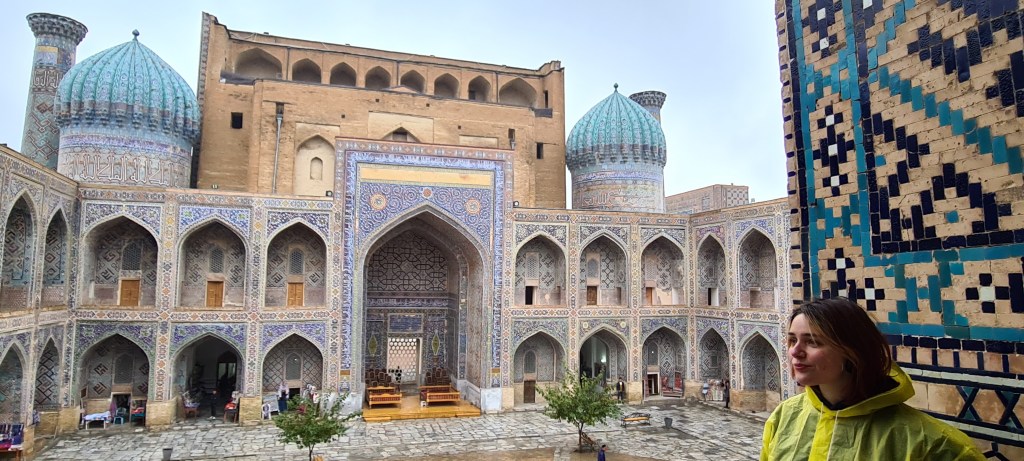
Ulug-Beg was the grandson of the all-conquering warlord Timur. Timur made Samarkand the capital of his sprawling empire and Ulug-Beg inherited part of it. Unlike his blood-thirsty grandfather, Ulug-Beg preferred the library to the battlefield, and is thought by some to have neglected his diplomatic and military obligations in his pursuit of academia.
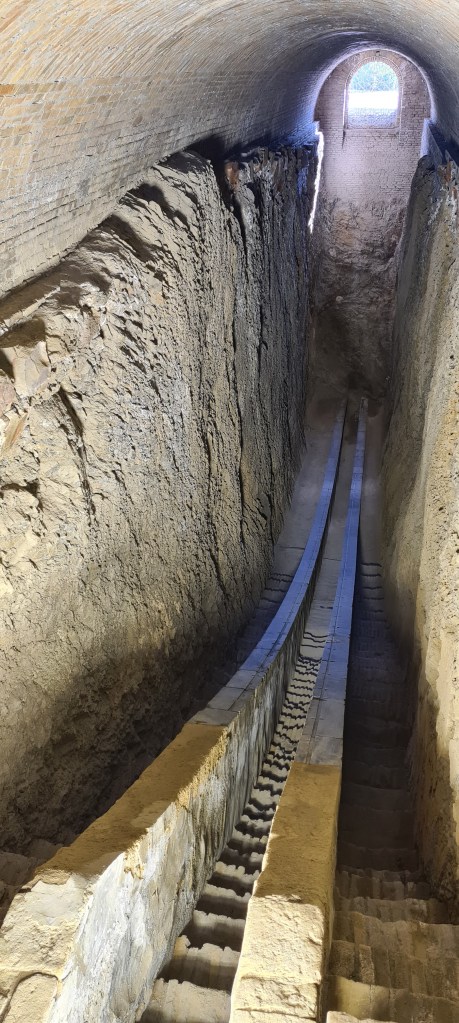
In addition to founding his large madrassa, which became a centre of learning in the Islamic world, Ulug-Beg also constructed an observatory to indulge his love of astronomy. The observatory included a gigantic, subterranean sextant with a radius of 40 metres. This enabled him to calculate the length of a tropical year to an accuracy of within 25 seconds (Copernicus was out by 30 seconds) and the tilt of the earth as 23.52 degrees (incredibly, for a 15th century astronomer, this is correct).
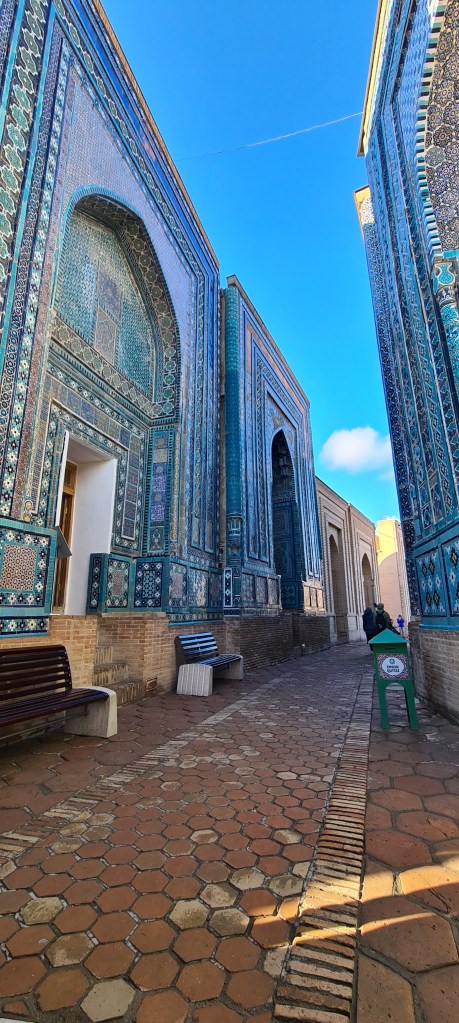
For a fan of Islamic architecture, Samarkand does not stop with the Registan. Towering mosques, echoing tombs and a beautifully ornate mausoleum complexes are dotted throughout the city. Alexander the Great said of Samarkand,
“Everything I have heard about the beauty of the city is indeed true, except that it is much more beautiful than I imagined.”
Ancient monuments have recently been joined by a mausoleum for Islam Karimov, and a separate large statue of him on horseback has also appeared. Karimov ruled newly independent Uzbekistan for 25 years; only his death put an end to his reign in 2016. Karimov’s regime was repressive and authoritarian, and in 2005 his soldiers fired on a civilian protest in the provincial city of Andijan. The Uzbek Government put the death toll at 187, but many estimates put it at several hundred higher.
Since Karimov’s death there have been some reforms. For tourists, these include the removal of the requirement for visas for many Western visitors, and also the lifting of an archaic, Soviet-era system whereby tourists were required to present a ‘registration form’, signed by their hotel(s), accounting for their whereabouts for every night of their trip. There were stories of a few unlucky travellers being fined thousands of US dollars for not being able to produce the required registration forms upon departure from Uzbekistan. Fortunately, it appears that the old system has all but disappeared – but many hotels still give the registration forms, just in case.
The tourist registration system may sound antiquated; the rail infrastructure is anything but. High-speed rail, with trains capable of reaching 250 kph, links the major cities. A highly efficient mobile phone app allows the easy purchasing of tickets, which can also be refunded immediately with a single click. The ticketing system is perhaps a victim of its own success: tickets can book up weeks, or even months, in advance.
If a seat is available, then a high-speed train across the desert from Samarkand to another great Silk Road city, Bukhara, makes traveling between the two a breeze.
Bukhara is arguably even more impressive than Samarkand. Although it lacks a centrepiece on quite the same scale as the Registan, it is more homogenously charming. Samarkand’s age-old landmarks are mixed in amongst modern buildings, whereas the whole centre of Bukhara is a maze of ancient sandstone buildings, with markets and street stalls galore and every alleyway leading to another undiscovered mosque or madrassa.
Bukhara’s huge fort is worth a visit, but the city’s most impressive landmark is the Kaylan Minaret. This 45m high tower was built in 1127. Its architect reportedly took two years preparing the foundations alone, leading to his contemporaries questioning his methods. But he was vindicated: the completed tower was the tallest structure in the region and, a hundred years later, even impressed Genghis Khan.
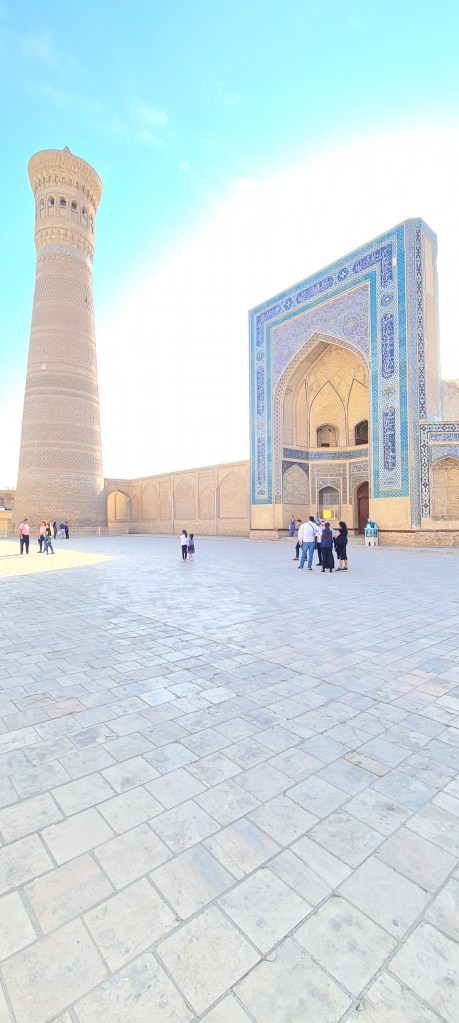
Genghis Khan arrived in Bukhara intending to raze the entire city to the ground. Legend has it that he stood at the base of the Kaylan Minaret and tilted his head back to look at the top of the tower. The steepness of the angle caused his hat to fall off, and the great Khan had to kneel to pick it up. Upon standing, Genghis Khan announced,
“I kneel for no man, but this tower has made me kneel. Therefore, it will be spared.”
Genghis Khan’s troops destroyed almost every other building in the city, but left the Kaylan Minaret untouched.
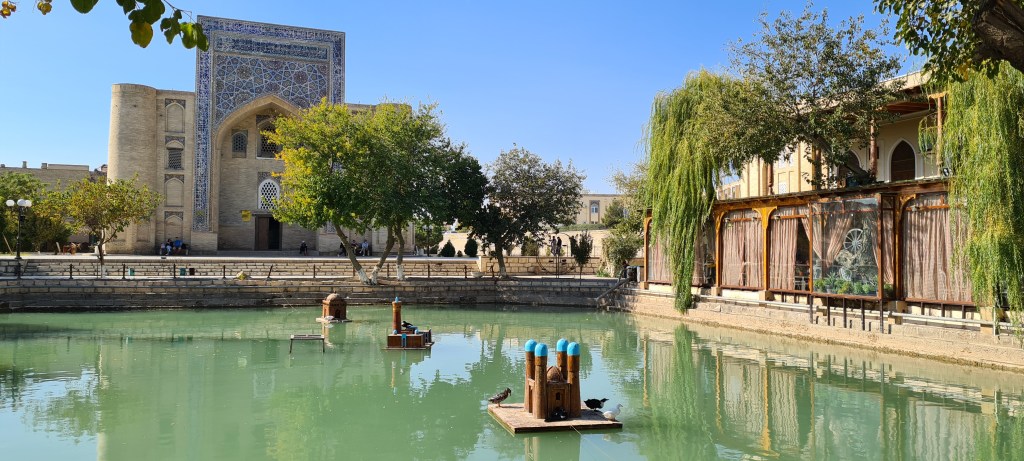
When not admiring the ancient architecture, visitors to Bukhara can relax around the Lyabi Khauz, an artificial pool at the centre of the city, surrounded by trees that cast a pleasant shade. Bukhara used to have dozens of such pools; given its desert location, water was scarce, and locals would both bathe in and drink from the pools. This led to water-borne diseases, including cholera, so the Soviets filled in many of the pools during their period of rule. The centrally-located Lyabi Khauz escaped, and today tourists can enjoy a refreshing drink or meal beside the water.
By night, a variety of restaurants will serve plov, the national dish. A mixture of rice and red meat, with a sprinkling of delicious dried fruit such as sultanas, it is often prepared in vast quantities and is said to date back to the time of the Timurid Empire in the 1300s.
And the easy-going atmosphere might throw a surprise up too: for example, wandering in (and being permitted to remain during) a Scandinavian heavy metal cello band sound-checking in a hotel before playing a set for a technology conference later that evening.

Uzbekistan is much easier to visit as a tourist than it was five years ago. If you are intrigued by ancient civilisations, monuments and tales of yesteryear, and also enjoy warm weather, then it should be top of your list to visit next.

 Somewhere Must Be Doing It Better
Leave a comment