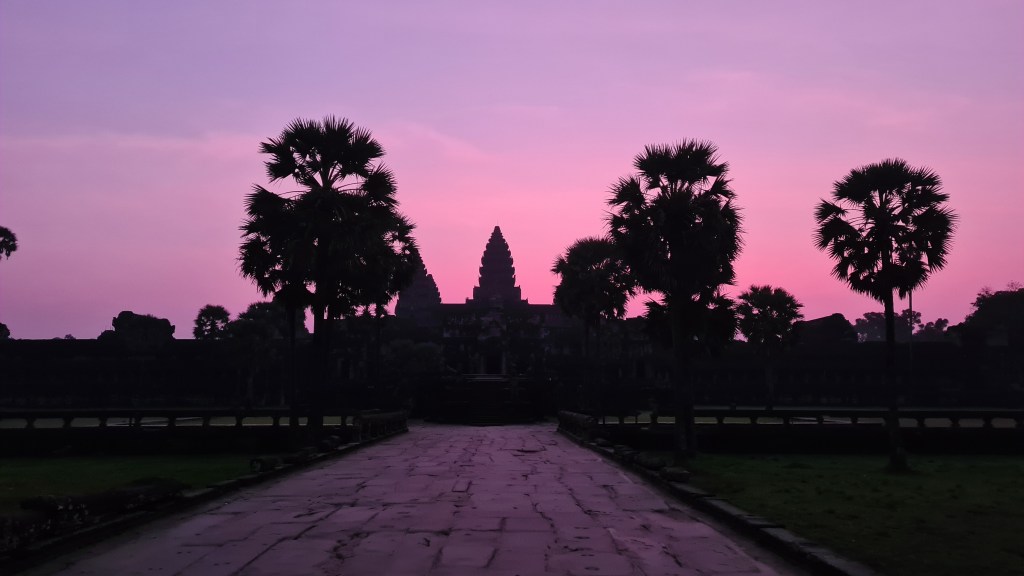
In 1860 French explorer Henri Mouhot hacked his way through the humid jungles of what is nowadays Cambodia, intrigued by tales of a vast, ruined city that had been reclaimed by nature. He discovered an ancient metropolis covered in vines and creepers, attacked by carnivorous banyan trees and forgotten by time. Today, we know this as the city of Angkor. At its centre lies its crowning glory, the magnificent temple of Angkor Wat.
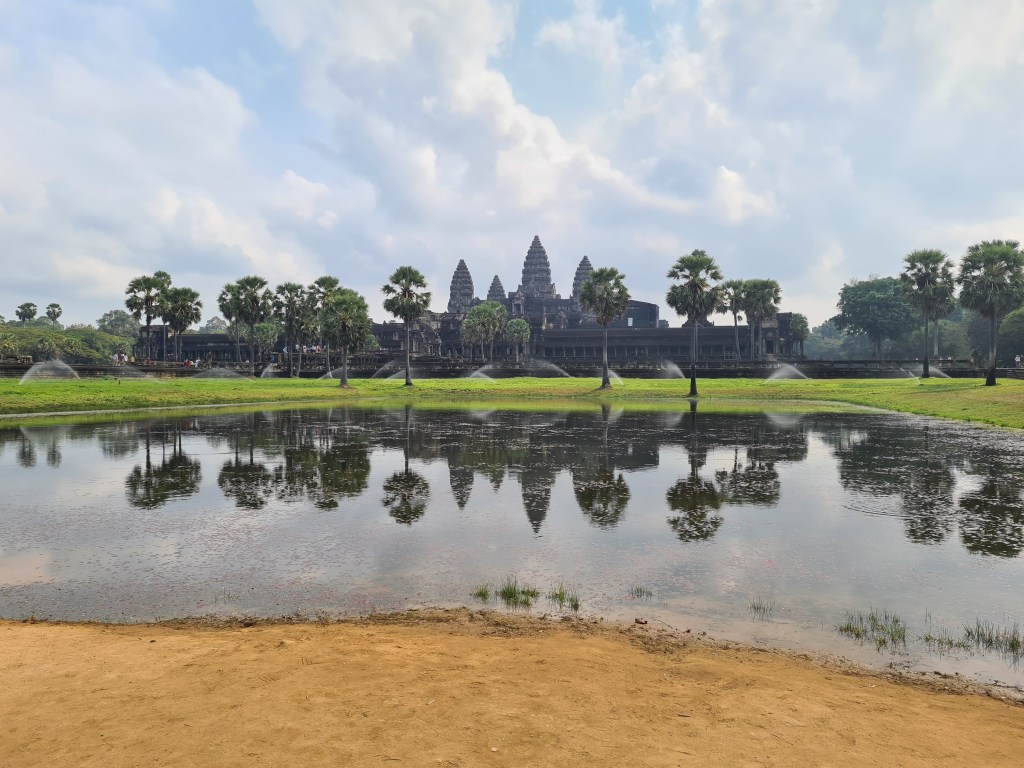
Angkor Wat draws millions of visitors of year, and for good reason. The temple is enormous, an architectural masterpiece to rival anything in the ancient world. Surrounded by a moat, huge walls enclose multiple galleries, extensive bas-reliefs decorate its sides, and its famous, lotus-shaped towers soar into the sky. His discovery moved Mouhot to write that Angkor Wat must have been erected by “some ancient Michelangelo”, and “is grander than anything left to us by Greece or Rome”.
The sheer scale of the surrounding site is even more impressive. The metropolitan area surrounding the ancient temple was home to around one million people. This was the 12th century; London’s population at the time was approximately 15 000. The inhabitants were sustained by a complex system of waterways, including two colossal reservoirs, each about five miles long and over a mile wide, possibly the largest structures created by humans at the time and visible from space. There are numerous immense ruined complexes such as East Mebon, Pre Rup, Bayon and Ta Prohm, any one of which could be a major attraction in their own right. The 2001 film Tomb Raider was shot partially at Ta Prohm.
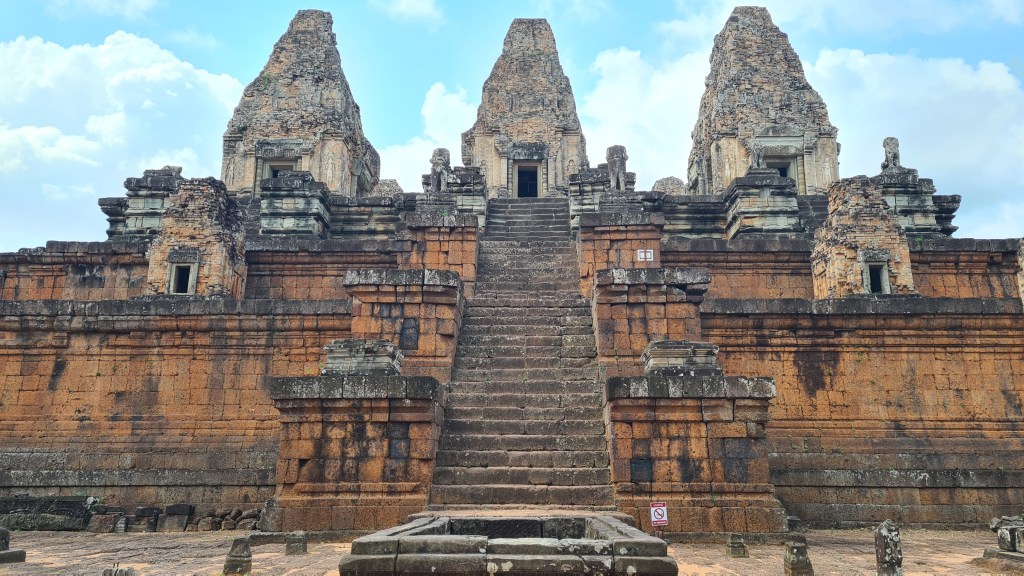

Part of the enigma surrounding Angkor Wat is what caused its demise. Just a few hundred years after its construction it was mysteriously abandoned and left for the jungle to reclaim, despite no archaeological evidence of armed struggle, plague or sudden natural disaster. One theory is that several decades of extreme weather, alternating between droughts and exceptionally heavy rainfall, overwhelmed the crucial water management system. Another is that the Khmer Empire’s economic system, which incentivised lords to exploit the peasants, broke down. It is possible that a switch in religion, from caste-based Hinduism to more egalitarian Buddhism, undermined previous hierarchies and caused the society to function less efficiently.
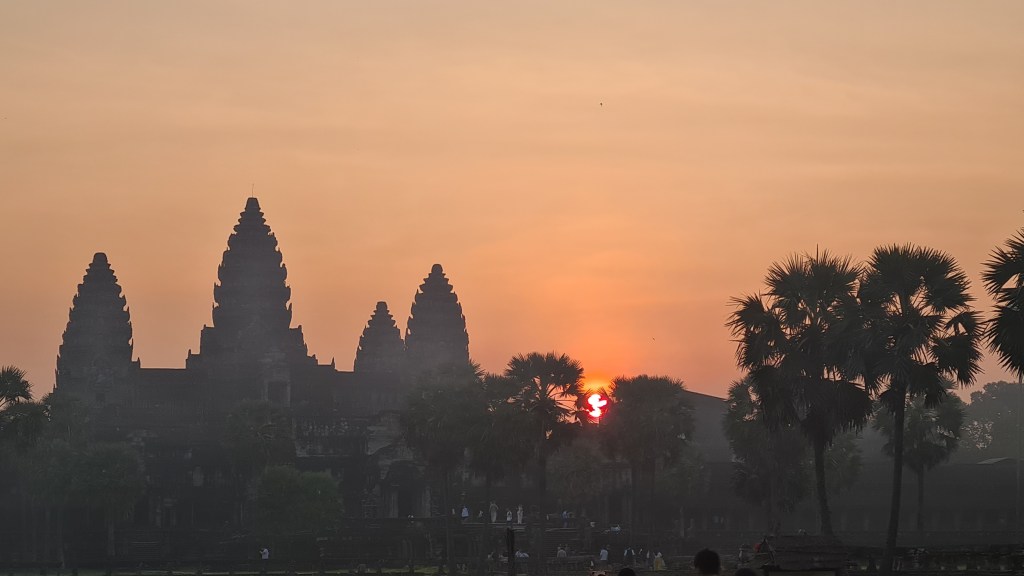
The true reasons may be lost forever to the sands of time, but the crumbling edifices of the once-glorious Khmer civilisation remain a sight on par with the Istanbul’s Basilica Cistern, the Taj Mahal or Samarkand’s Registan. Modern Cambodia honours its heritage with an image of Angkor Wat as the centrepiece of its flag. But other, more recent, historical influences also shape Cambodia today.
One is the post-colonial influence of the French. Cambodians appear to have a much less negative collective memory of colonial times than many other nations. “We like the French,” smiled one tour guide at Angkor Wat, as he explained how the French helped with the restoration of the lost city. The French also allowed the Cambodians significant autonomy, and helped them regain territories previously lost to neighbours such as Thailand (the translation of ‘Siem Reap’, the name of the city next to Angkor Wat, is ‘Thai surrender’). They left behind a fondness for cycling that is much more marked than many other Asian countries, where the sight of a bicycle is rare. Indeed, the Cambodians seem keener on exercise than many of their neighbours. Large-scale dance classes are found on the pavements shortly after dusk, with dozens of Lycra-clad locals moving to a beat emanating from a portable speaker system.
Despite the glorious history of the Khmer Empire, and the modern freedom from colonialism, a long, dark shadow hangs over the whole country: the trauma of four years of rule by the genocidal Khmer Rouge regime, headed by the murderous Pol Pot.
In 1975 Pol Pot swept into the capital, Phnom Penh, and took power after years of brutal civil war. He immediately instituted an extreme form of communism, attempting to transform the country into an agrarian utopia by forcefully expelling everyone from the cities and sending them to forced labour camps to grow rice. Within days, the capital was empty. Money was abolished and a barter economy introduced. Anyone deemed a threat to the regime was killed; many middle-class professionals fell into this category. In a stroke of staggering hypocrisy, teachers were counted amongst those to be eliminated, despite Pol Pot and several of his cabinet being ex-teachers themselves. Speaking a foreign language was also enough to warrant execution, despite Pot and many of his cronies having studied in Paris.
Standard practice was to hold those listed for execution in a ‘re-education’ centre and torture them for a confession. Once the confession was secured, they would be transferred one of many ‘killing fields’. There they were murdered with a blow to the head using a farm implement, since bullets were deemed too precious to waste. The entire family of the executed individual would also be executed; the Khmer Rouge reasoned that this was necessary to prevent the family seeking revenge in future.
Today one of the many sites of executions, the Choeung Ek Killing Fields, are open as a memorial to the public. Wandering through, fragments of bones and the remnants of clothing are visible in amongst the grass. The staff clear them away, but rains and erosion constantly expose more remains from the mass graves. A tree where the Khmer Rouge killed babies by striking their head against its trunk is also preserved.
Vietnam finally put a stop to the senseless massacres by invading in 1979. Cambodians today seem grateful for the invasion. The Khmer Rouge fled Phmon Penh and retreated to the mountains and jungles near the Thai border, where they continued to wage guerrilla warfare for more than a decade.
Over two million Cambodians, more than a quarter of their population of eight million, were killed by the Khmer Rouge. It is one of the most brutal and violent episodes of the entire twentieth century’s long and bloody history. The crimes were in plain sight immediately after the Vietnamese invaded: foreign journalists visited Phnom Penh, and later that same year, in 1979, the Cambodians opened the Tuol Sleng Genocide Museum at the site of one of the most notorious detention centres, where 20 000 prisoners were kept, yet only seven survived.
Incredibly, and shamefully, the West continued to recognise the Khmer Rouge as the legitimate government of Cambodia throughout the 1980s, in the decade after the genocide. In one of the most grotesque episodes of Cold War realpolitik, Reagan and Thatcher applied the maxim ‘My enemy’s enemy is my friend’ to Cambodia. That is, Pol Pot was their friend in the 1980s since he was fighting against the Vietnamese-backed new Cambodian regime, and the West opposed the Soviet-allied Vietnamese communists.
There are allegations that the British SAS trained Khmer Rouge soldiers in those post-genocide days of the 1980s when the Khmer Rouge were back in the jungle, trying to fight the Vietnamese regime now in control of Cambodia. The British Government denies this, though it seems certain that they trained close allies of the Khmer Rouge, if not the Khmer Rouge themselves. The Americans have similar murky ties. These are likely to never fully see the light of day, but it is a matter of public record that the Khmer Rouge retained their seat at the United Nations as sole representatives of the government of Cambodia for over three years after they were ousted from power in the country, and remained the dominant force in a coalition that held the seat for another decade.
In the face of such harrowing history it is difficult to know what, if anything, an individual can do to help nowadays. One option is to support the Cambodian economy by including the country on your itinerary if planning a holiday to more popular South-East Asian destinations such as Thailand or Vietnam. If in Phnom Penh, give blood. There is a nationwide shortage and this is one of the few genuinely useful ways a foreigner can volunteer. It is easy to turn up at the Cambodian National Blood Transfusion Centre, with no appointment required, and you will be rewarded with a generous packed lunch as a thank-you.
Otherwise, consume media relevant to what has happened. First They Killed My Father is easily accessible on Netflix. It is an American production, but it is based on a book by the same name written by a Cambodian, and utilised a Cambodian cast. Alternatively, to access the arts from a direct Cambodian source, try poetry.
Hear Me Now was written by Sophal Leng Stagg, who was nine years old when the genocide started. An excerpt reads:
Run away to peaceful days,
Mother please stay with me,
Don’t go, please stay close to me.
I need you now to help me see,
To see the days of peace for me.
Help me find those peaceful times,
The times we laughed when we were free,
No more pain, be at peace.
 Somewhere Must Be Doing It Better
Leave a comment