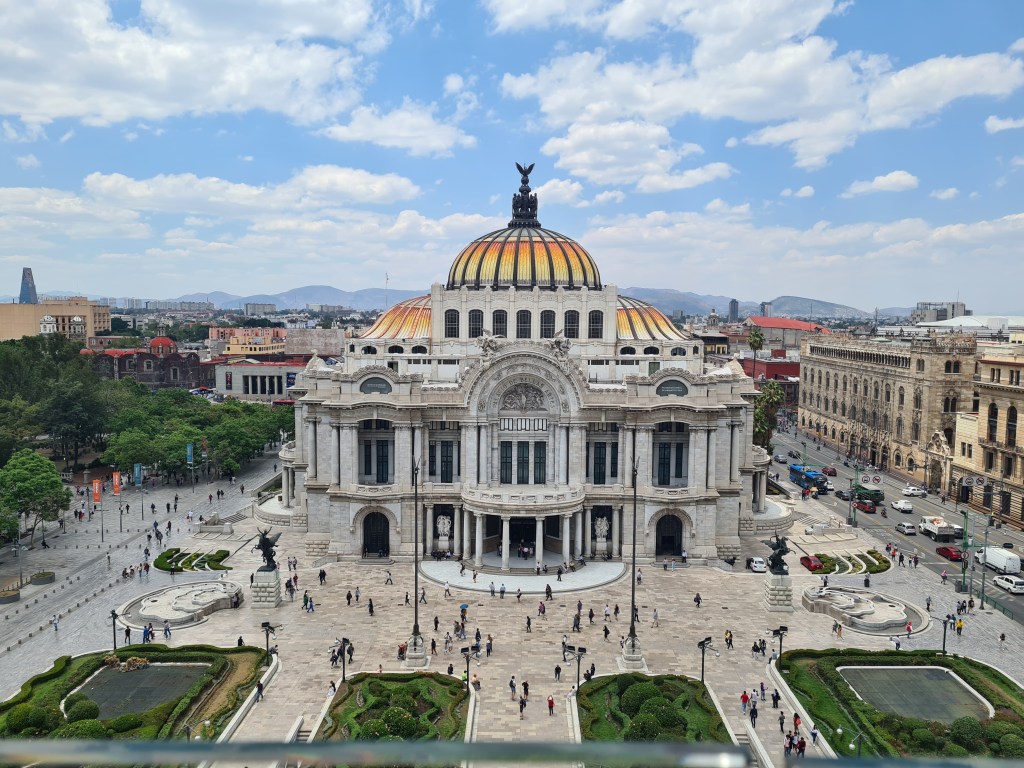
Mexico City, Ciudad de México in Spanish and CDMX for short, is the world’s fifth-largest city. You will never run out of things to do in this sprawling, busy but welcoming metropolis. Grandiose squares, lively markets and around 150 museums are found in the centre. Ancient canals and houses of famous artists lie in the suburbs, and some of the largest pyramids in the world are nearby in the ruined city of Teotihuacán. All this, and more, ensures there is a packed itinerary awaiting anyone who wants it.
CDMX is centred around Zocalo, an enormous central plaza with a beautiful cathedral and Aztec ruins in the adjacent block. In fact, many of the buildings in the centre use Aztec masonry for their bases, as this was the most easily available building material for the sixteenth century Spanish conquerors. The bottom few layers of stone of any unremarkable building may reveal carvings of eagles and snakes, sculpted by the civilisation that predated the current one.
For the energetic, the city can be explored using one of the free bikes that are available to hire every Sunday until 2pm, when one of the main avenues, Reforma, is closed to traffic. This results in Reforma being packed with hundreds of cyclists, and runners, enjoying the tree-lined avenue completely free of vehicles. One evening every month the police also close a different set of roads for a ‘night-ride’, where cyclists and rollerbladers can gently cruise through the streets, accompanied by music. Other countries should follow this lead – undoubtedly it is good for the environment and for the health of the participants too.
Street food is a major part of Mexican culture. Taco stands are on most corners, and many Mexicans take their main meal at lunchtime, following this with a smaller meal in the evening. After tacos, pozole is another example of classic Mexican cuisine. It is an adaption of an old Aztec dish. Although the Spaniards were bloodthirsty conquerors themselves, the original pozole proved too much for their tastes: it was a stew made with human flesh. The conquistadors banned this, and dog meat was the initial substitute. Nowadays, pozole is made with chicken or pork.

For evening entertainment, the full spectrum is on offer. For more refined tastes, a visit to the Palacio de Bellas Artes opera house to watch the Ballet Folklorica is recommended: this troupe shows off traditional dances from all over Mexico. The musicianship of their instrumentalists is also a sight to behold.
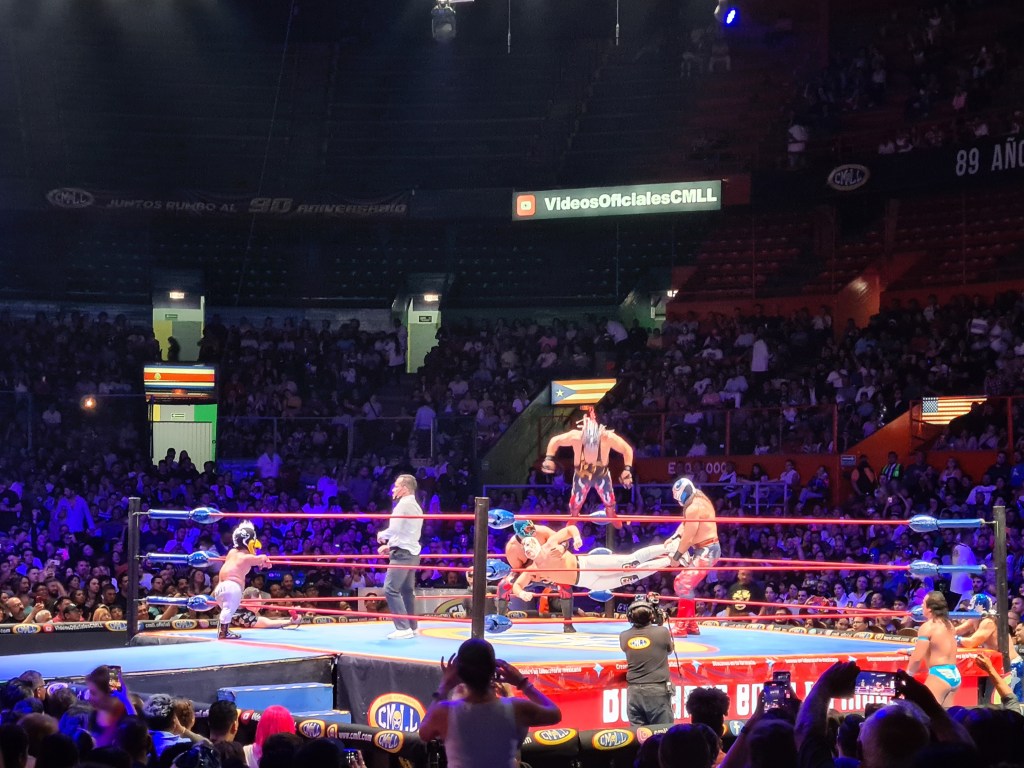
At the other end of the scale, Lucha Libre Mexican wrestling is on offer most nights at Mexico Arena, where a lively crowd of thousands boos and cheers masked warriors as they acrobatically accost one another. Lucha Libre is fun, but do not expect political correctness: the show included an over-the-top flamboyantly camp, ‘gay’ performer, a black wrestler whose stage name was ‘Black Magic’, and a little person, with achondroplasia, portrayed in a demeaning fashion. Perhaps most shocking of all was when an actual child, probably nine years old, entered the fray. The adult wrestlers went easy on the child, but he was still launched into the air and hit the side netting.
Mexico City is proud of its famous residents. Two of the best known are the artist, Frida Kahlo, and her husband, Diego Rivera. Interestingly, although Kahlo is much more famous in the rest of the world, Rivera is the more revered of the two in their home country. One can speculate this is partly due to the nature of their work: Rivera painted mostly murals, which are not portable and therefore his work could not be exported to the rest of the world, whereas Kahlo’s paintings are much easier to ship to an exhibition or auction in Europe, South America or the US.
Rivera’s murals are found throughout the city. In the 1920s the Ministry of Education commissioned Rivera to decorate their premises; nowadays tourists can wander in, free of charge, and admire dozens of the famous artist’s works. One striking image displays the rich sitting at the dinner table, staring forlornly at inedible chunks of gold on their dinner plates, whilst the workers beam at a bountiful harvest and hold sheaves of wheat in the background.

A particularly famous Rivera mural, ‘Man Controller of the Universe’, is found on the top floor of the Palacio de Bellas Artes. Rivera was commissioned by the world’s richest man at the time, John D Rockefeller Jr, to paint an enormous mural in the Rockefeller Centre in New York City. Perhaps Rockefeller was unaware of Rivera’s communist leanings, or maybe he thought the artist would tone it down. If the latter, then Rockefeller was naïve; Rivera created a sweeping mural, with capitalists clearly shown in a negative light on one side and communists portrayed favourably on the other. Rockefeller promptly had the mural destroyed, so Rivera re-created it in the Palacio de Bellas Artes in CMDX. Intriguingly, the recreated mural includes a depiction of Rockefeller himself, and seems to imply that he was suffering from venereal disease. Local guides suggest that perhaps Rivera knew something that the world at the time did not – they claim that a short time later John D Rockefeller Jr died of syphilis – though after verifying this online this cause of death does not appear to check out.
Like many other major landmarks, the construction of the Palacio de Bellas Artes was initiated by Porfirio Díaz, a general who ruled Mexico for 31 years around the turn of the 20th century. Díaz also oversaw the creation of the railways and a period of modernisation, but the length and nature of his rule has led to many viewing it as a dictatorship. The period is often referred to as the ‘Porfiriato’. It is difficult not to notice that, despite his questionable democratic credentials, many high-end cafes, bars and other establishments are named after him to this day. When asked about how he is viewed in contemporary Mexico, one local replied, “Under his rule, the rich did well. The poor – not so well. Nowadays he is associated with classiness…a fancy restaurant might be named after him.”

Despite this dubious unofficial honouring of the Portfiriato, Díaz does not have the privilege of having his birthday marked as a public holiday in Mexico. That is reserved for Benito Juárez, who served from 1858-72, and remains Mexico’s only indigenous president. Juárez was a progressive, liberal reformer who worked on issues such as equal rights for the nation’s indigenous population, civil liberties, freedom of worship and reduction in the power of organised religion and of the military. He also defended the country against invasion by Napoleon III of France.
No visit to Mexico City would be complete without a visit to the Casa Azul (Blue House), Frida Kahlo’s home. The story of the troubled artist’s life, suffering polio as a child followed by a gruesome traffic accident as a teenager that left her hospitalised for weeks and with complications for life, is tragic, but what she achieved in the face of adversity is remarkable. In her art she regularly portrayed herself in traditional Mexican dress, and was a trailblazer in terms of emphasising features not seen as conventionally attractive, such as her prominent eyebrows that ran into each other across the bridge of her nose.
Today Frida Kahlo is world-famous and reproductions of her art adorn boutiques, souvenirs and galleries the length and breadth of the country. One wonders what the artist herself, with her membership of the Mexican Communist Party, would have made of ‘Fridamania’ and the relentless commercialisation of her image. Whatever she would have thought, her fearlessness redefined the parameters of beauty for her generation and many subsequent ones.
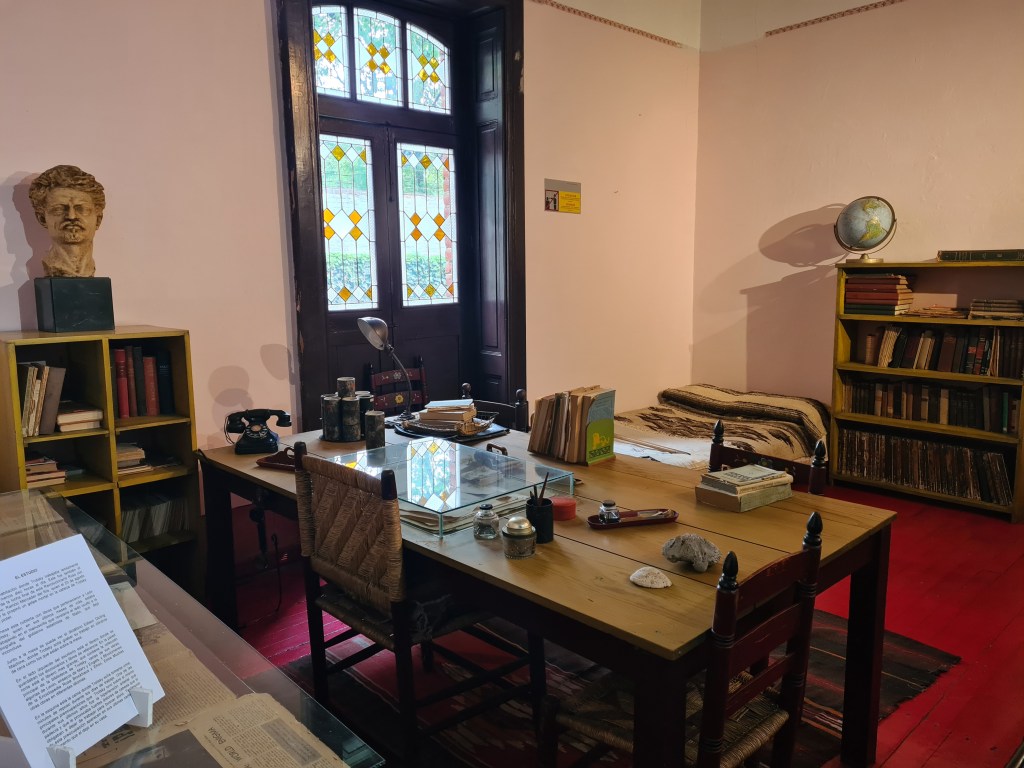
Not far from Frida and Diego’s villa is another tourist attraction: the house of Leon Trotsky. Alongside Lenin, Trotsky was one of the main communist leaders during and after the Russian Revolution and in the fledgling Soviet Union. After Lenin’s death he lost out to Stalin in the ensuing power struggle and was forced to flee. Rivera petitioned the Mexican government on Trotsky’s behalf and Trotsky eventually ended up living out his exile in Mexico City, staying with Rivera and Kahlo for part of that time. He even had a brief affair with Frida Kahlo though, given both her and her husband’s numerous infidelities, this is not surprising.
The building houses a small museum and is faithfully recreated to demonstrate how it would have appeared almost a century ago. It feels more authentic than Frida Kahlo’s house: less commercialised, and probably more in tune with how the original, left-wing inhabitant would have wanted it. It makes no mention of the fact that Trotsky himself must have been responsible for thousands, if not millions, of deaths, during his time as one of the USSR’s early leaders.
Indeed, it is an example of the curious following that the man still commands, especially compared with contemporaries such as Lenin. Maybe Trotsky’s intellectual sensibilities engender a feeling of comradeship amongst modern day acolytes. Perhaps, too, there is an element of martyrdom involved. One room in the museum displays a photo of Lenin’s cabinet, from around 1920. A plaque underneath explains that, by January 1940, every single cabinet member except Trotsky was dead due Stalin’s purges. Of course, that would not last long: a few months later Trotsky had gone the same way, dispatched by an ice-pick to the cranium, courtesy of an assassin sent by Josef Stalin.
A city of over 20 million people needs an efficient way of transporting its populace, and Mexico City has a well-developed mass transit system. Its buses run in lanes that are completely separated from the normal traffic lanes by concrete barriers, and stop at bus stops that are like miniature train station platforms or tram stops, with barriers requiring a card to be swiped for entry. The result is that the buses run quickly and smoothly; the system seems much like a tram system, but must be far cheaper to set up since no rails or wires need to be laid or installed. All public transport comes with large women-only zones too, denoted by different coloured handrails and signage. For those who prefer walking, the roads are largely clean (despite an absence of bins) and smoking is completely banned on the street.
A visit to Mexico City is, thus, highly recommended…at least, at any time other than September. On 19th September 1985 a magnitude 8.0 earthquake struck Mexico City with disastrous results. On 19th September 2017 a magnitude 7.1 earthquake struck the region again. Even last year, on 19th September 2022, an earthquake struck the Mexican coast, between the states of Michoacán and Colima.
That these earthquakes have occurred on 19th September may be a coincidence, but locals in Mexico City all warn that September is ‘earthquake month’. Unfortunately, Mexico City is built on an old lakebed, with soft soil and an ongoing subsidence problem. When quakes strike the soft ground is easily shaken, and estimates for the death toll in 1985 range from 5000 to 50 000. Casualties have been fewer in the more recent instances, but earthquakes remain a danger.
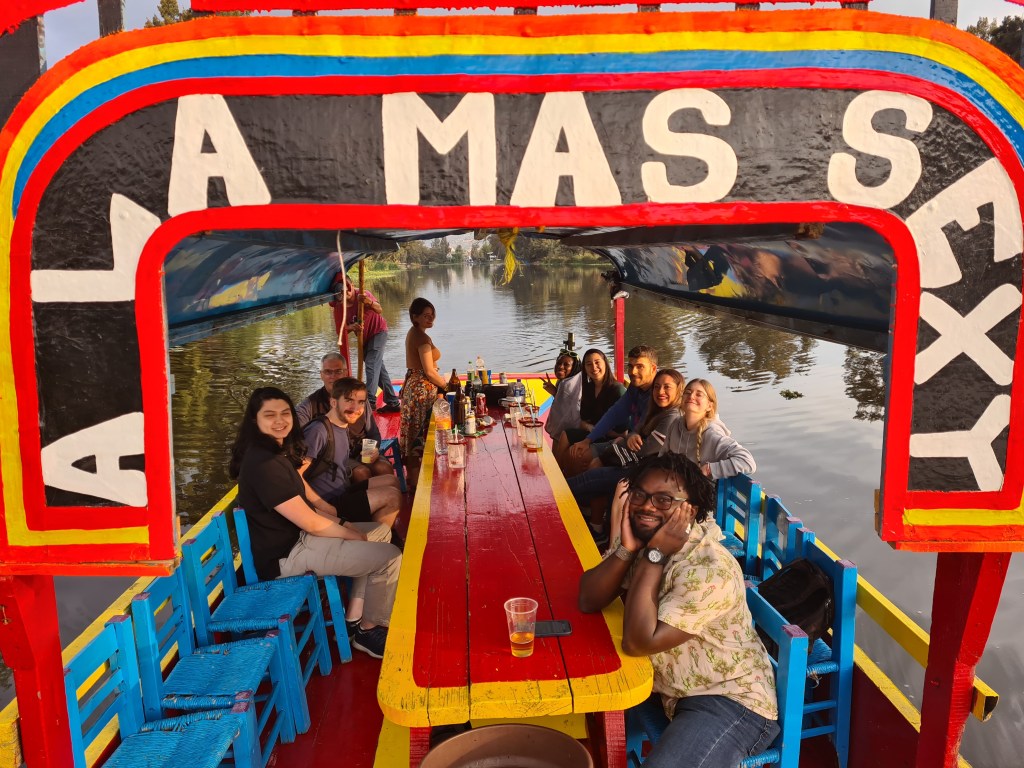
Earthquakes aside, CMDX has too many other attractions to list. There are the ancient Aztec canals of Xochimilco, a free zoo in the beautiful Chapultepec Park which boasts a panda, a white tiger and two jaguars, and a large castle with commanding views of the CDMX skyline. Plaza Garibaldi, in the city’s centre, is famous for its traditional mariachi bands, and an official notice warns that when arriving in the plaza:
You have to be prepared to exceed the common limit of alcoholic consumption. In other words, it is expected that whoever arrives at Garibaldi is already drunk…[translated from Spanish]
If animals, history or drinking are not your vibe then you can visit the leafy, upmarket district of Roma Norte, to be confounded by the profusion of dog-grooming shops, have your heart-strings pulled at in the ‘Museum of Broken Relationships’, or enjoy an alcohol-free evening of entertainment at a board game bar.
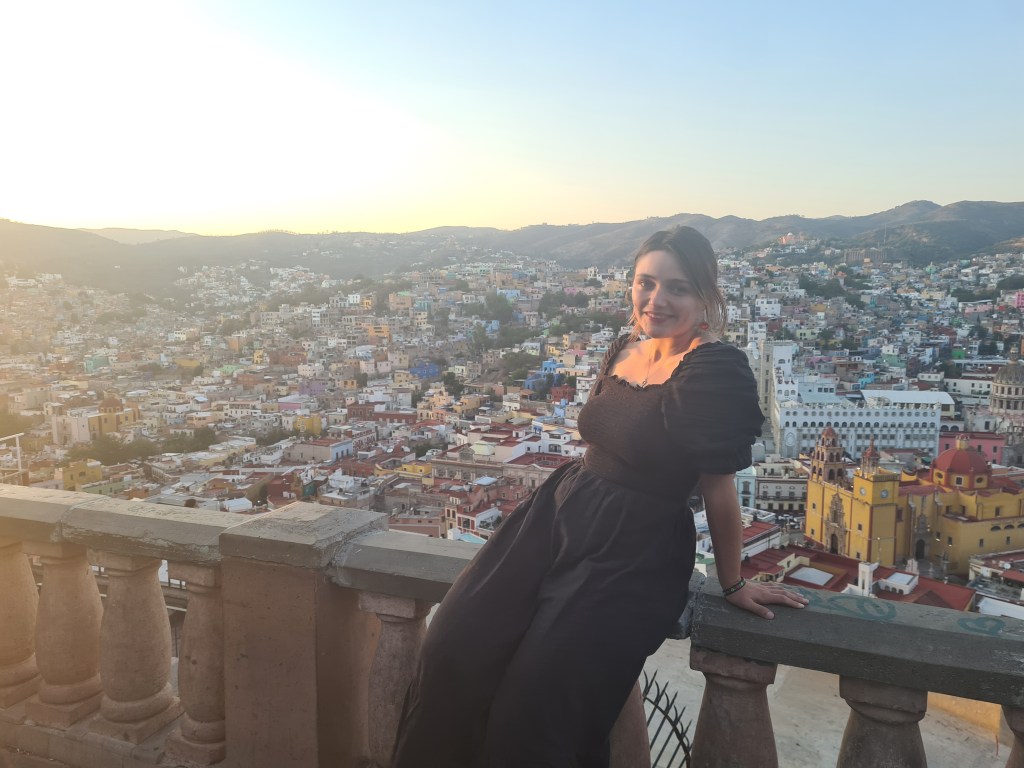
A coach ride from Mexico City takes you to the university town of Guanajuato. Nestled in the mountains at an elevation of 2000m above sea level, Guanajuato offers a charming, if somewhat unusual, mixture of street theatre, tunnels and mummies(!) It offers another example, like Mexico City, of central Mexican culture, very different to famous beach resorts like Cancún or Tulum.
In the city centre, eight of the nine mythical muses peer down at tourists from the roof of another of Porfirio Diaz’s constructions, the beautiful Teatro Juárez. It is in front of this theatre that Callejoneadas start their evening entertainments. Callejoneadas are theatrical companies that sing, dance and tell stories to tourists whilst leading them on a whirlwind tour round Guanajuato’s winding streets and labyrinthine alleyways. They started as students in 1881, though today most are professional.
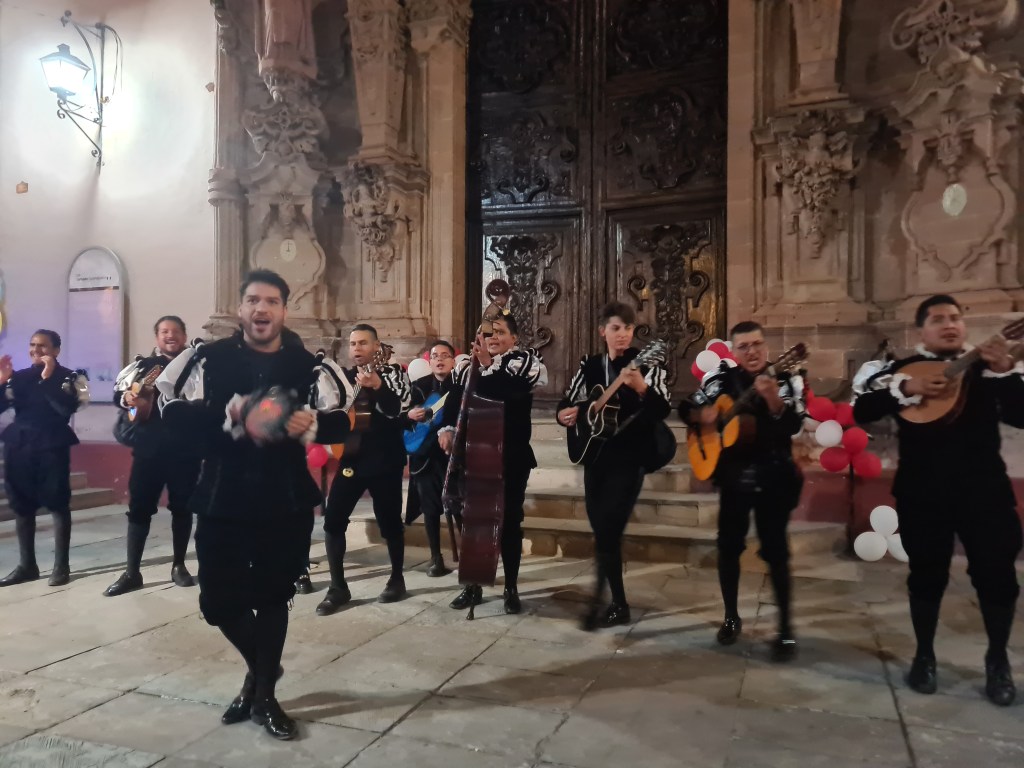
One favoured spot for the Callejoneadas is the ‘Alleyway of the Kiss’. According to local legend, many years ago one of the houses on the narrow alleyway belonged to a rich family. A local young man, who was very poor, fell in love with the daughter of the family, but the rich father forbade the two from meeting on the basis that the man’s poverty made him an unsuitable match. The young man responded by renting the house directly opposite, across the alleyway. The alleyway was so narrow that if the poor man stood on his balcony, and the rich woman stood on hers, they could lean across and kiss.
Some in the modern world might expect the father to be impressed with such a resourceful solution. Alas, this was not the case. When the father caught the lovers embracing across the balconies he killed the daughter in a fit of rage. The heartbroken young man consequently committed suicide, and so the sad story ends. Present day couples can expect seven years of good luck if they stand in the alleyway below the balconies and kiss.
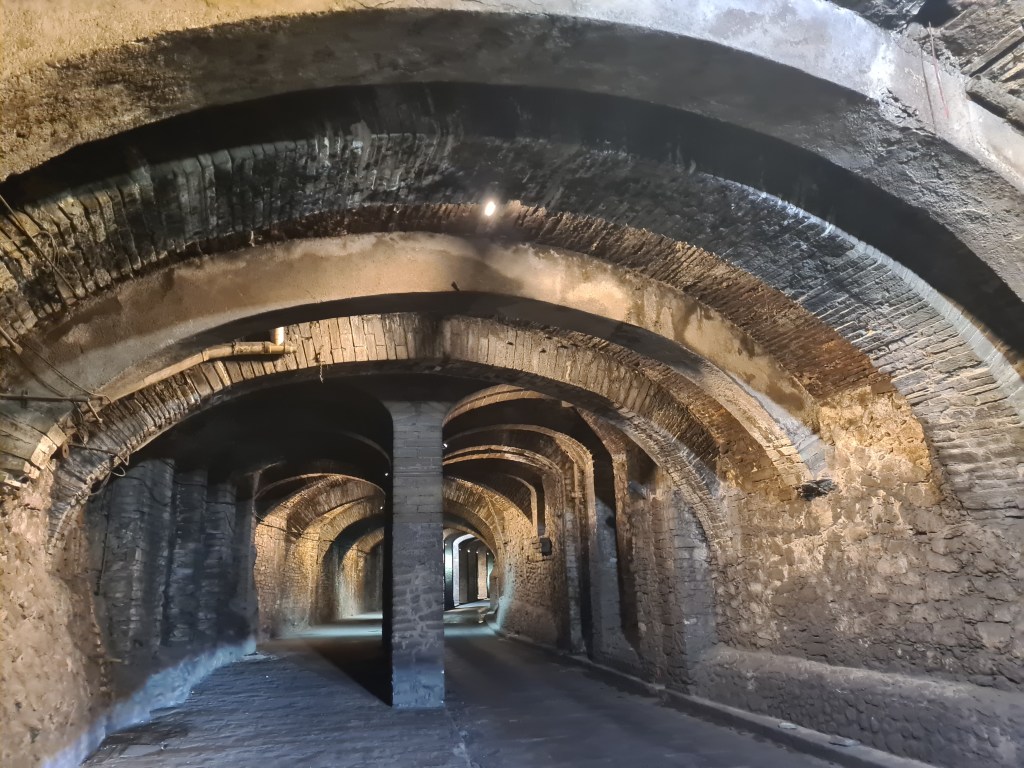
Guanajuato has many such curious alleys and paths, but it is also known for its extensive network of tunnels. It was founded as a mining town – once upon a time 40% of the world’s silver was produced from Guanajuato’s mines – and the locals were skilled at burrowing through mountainsides. An extensive network of large tunnels grew up underneath Guanajuato as a result, originally to channel its river away from flooding local homes, and latterly to carry cars and foot traffic. Although dimly lit and smelling of exhaust fumes, there are some spots of beauty, such as the twin-arched section underneath the town’s historic centre, and the numerous spots where the tunnels open to the skies above.

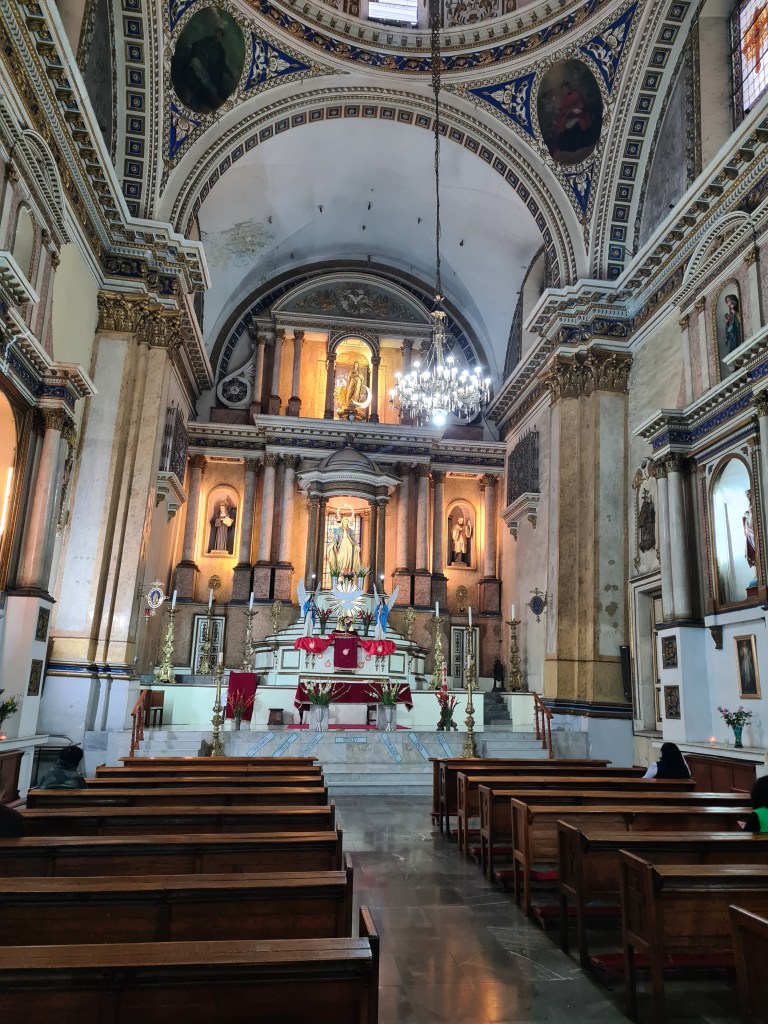
Guanajuato’s Catholic churches are worth visiting too. Although none are officially cathedrals, at least three are of cathedral size and grandeur. Spend long enough in Mexico and you will encounter a religious parade too; such processions regularly fill the streets. In some parts of the country, people can also be seen carrying small, devotional figures of Santa Muerte (Saint Death) to their once-monthly blessing. The amalgamation of pre-Hispanic religious beliefs with saints’ hagiographies is a common theme in Mexico. Despite condemnation from the Catholic Church, Santa Muerte’s cult is becoming increasingly popular.
Speaking of death, no discussion of Guanajuato is complete without mention of one of the town’s most famous attractions: its collection of mummies. In the late 19th century, with burial sites at a premium, the town’s authorities came up with an alternative: rather than paying up-front for an expensive tomb, locals could rent a spot instead. Unsurprisingly, some deceased but nevertheless still rent-paying clients fell into arrears, resulting in a spate of posthumous evictions, often less than ten years after the original burial.
But there was a twist: somehow an unusual set of atmospheric conditions, perhaps partially due to chemicals from the local mines, had resulted in many of the corpses being mummified. These mummies, mostly around a hundred years old, are displayed today in the macabre Mummy Museum. The ethical question of whether it is right to display these peoples’ remains without their or their families’ consent is not addressed. The museum contains mummified remains of children and babies as well as adults, and has a section on violent deaths, including a mummy with a stab wound, surrounded by discoloration left by bleeding, a mummy that drowned, and a mummy that may have been buried alive. The ‘world’s smallest mummy’, a foetus retrieved from the mummified womb of a pregnant woman, is also on display. Facing so many extinguished lives the overwhelming emotion is sadness. What were these people’s stories? Did they live happy lives? Was there more that they wanted to accomplish before they passed away? You may leave the museum with more questions than answers.
Leaving these two cities, it is easy to see how much Mexico has influenced world culture. Perhaps we should import even more of their ideas. Next time you eat a taco, consider whether the Mexican policy of teachers having free admission to all museums should be implemented back home – surely it makes sense to educate the educators? When you add tabasco sauce think about the priority CMDX gives to its buses, and the women-only zones that the trains have installed. If you throw your hands up in a Mexican wave, why not throw your hands up for closing big roads to traffic on Sundays and lending everyone a free bike to enjoy the city that day? And next time you examine the mummified remains of a recently deceased child…okay, we can leave that bit out.
 Somewhere Must Be Doing It Better
Leave a comment